As I’m watching season 7 of Chef’s Table, episode 3 covers Angel Leon and his quest to promote seafood charcuterie. His restaurant, Aponiente in Cadiz, Spain, has now been awarded 3 Michelin stars and Chef Leon is passionately committed to taking local ingredients and transforming Spanish cuisine. One of the big innovations was to make charcuterie-style sausages with lesser known fish caught off the coast. But what caught my attention for our purposes here at Great Lakes Cuisine was the potential to do something similar with local fresh water fish. Given our long tradition of sausage making here in Wisconsin, this seems like a natural extension. So why not a whitefish bratwurst?!?

Now, quick couple comments before we dive into our recipe below. First, I have to acknowledge the initial inspiration for this comes from the “lobsterwurst” with mascarpone pierogis made by Jason Gorman, now the Executive Chef at the TD Garden in Boston. Chef Gorman made this for our private party while he was the acclaimed chef de cuisine at Dream Dance in Milwaukee. His innovative takes on Great Lakes cuisine was one of the initial inspirations for this entire Great Lakes adventure we’ve been on since 2010.
Also, Hank Shaw has been on this idea for a number of years before we finally came around to discovering it. Both Hank and Chef Leon use fatty fish to mimic the pork fat typically present in the sausage making process. Those fatty fish are not available in our fresh water lakes, so we substitute in cultured butter (see note below for description and source).
This whitefish bratwurst has all the flavors and textures that you’d want in a bratwurst. If you want to serve it as a bratwurst, meaning in the bun with all the fixings, see the note below on casings. Detailed here is service as an appetizer portion. If not told it was whitefish, I believe many people would simply assume it was a traditional, but somewhat more tender, bratwurst. That was exactly our intention.
Whitefish Bratwurst
1 pound fresh whitefish, hand chopped to a fine dice
4 Tbs cold, cultured butter, hand chopped to a fine dice (see note)
For the Spice Mixture:
1/2 tablespoons salt
1/2 teaspoons freshly ground white pepper
1/4 teaspoon freshly ground black pepper
1/2 teaspoon ground mace (can substitute nutmeg but mace will bring traditional German flavor)
1/4 teaspoon ground ginger
1/2 teaspoon fresh thyme (though marjoram is more traditional)
1/4 teaspoon mustard powder
1/4 teaspoon crushed caraway seed
pinch ground cardamom
pinch ground coriander
Note: We like Nordic Creamery’s product. Cultured butter is fermented before being processed into butter. Fermentation increases the fat content in butter, increasing richness and adds a slightly tangy taste. Substitute a high quality butter if cultured butter is unavailable.

See additional ingredients for service.
Directions:
The whitefish and butter should be kept very cold. After chopping both into a fine dice, mix with all the spices and place back into the refrigerator to chill for one hour.
Three options for preparation. You could always use hog casings or order sheep casings (which Hank Shaw recommends, and I always trust Hank) and stuff the casings just as you would any other sausage. You can also prepare these simply as patties and serve them on a hamburger bun or with a traditional slaw. Our preparation involved wrapping the fish mixture about the size of a sausage in plastic wrap and tying each end. We then dropped them into a pot of simmering water (just off a boil) for a few minutes until the fish turns opaque and the sausage “sets” in it’s shape. Heat a cast iron pan with 1 additional tablespoon of butter on medium high heat until the butter is melted. Then carefully cut one end of the plastic and squeeze the sausage into the cast iron pan. Cook until nicely browned.
Additional Ingredients for Service:
3 pieces multi-grain bread, toasted lightly
3 Tbs. stone ground mustard (We used Koop’s)
1 Tbs cultured butter
1/2 red onion, thinly sliced
1/2 head of small red cabbage, finely chopped, core removed
1/4 cup apple cider vinegar
1/2 teaspoon of liquid smoke (see note)
Note: We used the skin of a smoked whitefish fillet to flavor the butter before removing it when we added the onions. We processed the smoked whitefish into a dip that was served alongside the whitefish brats. But assuming you do not have a smoked fish skin handy, we suggest liquid smoke.

Directions:
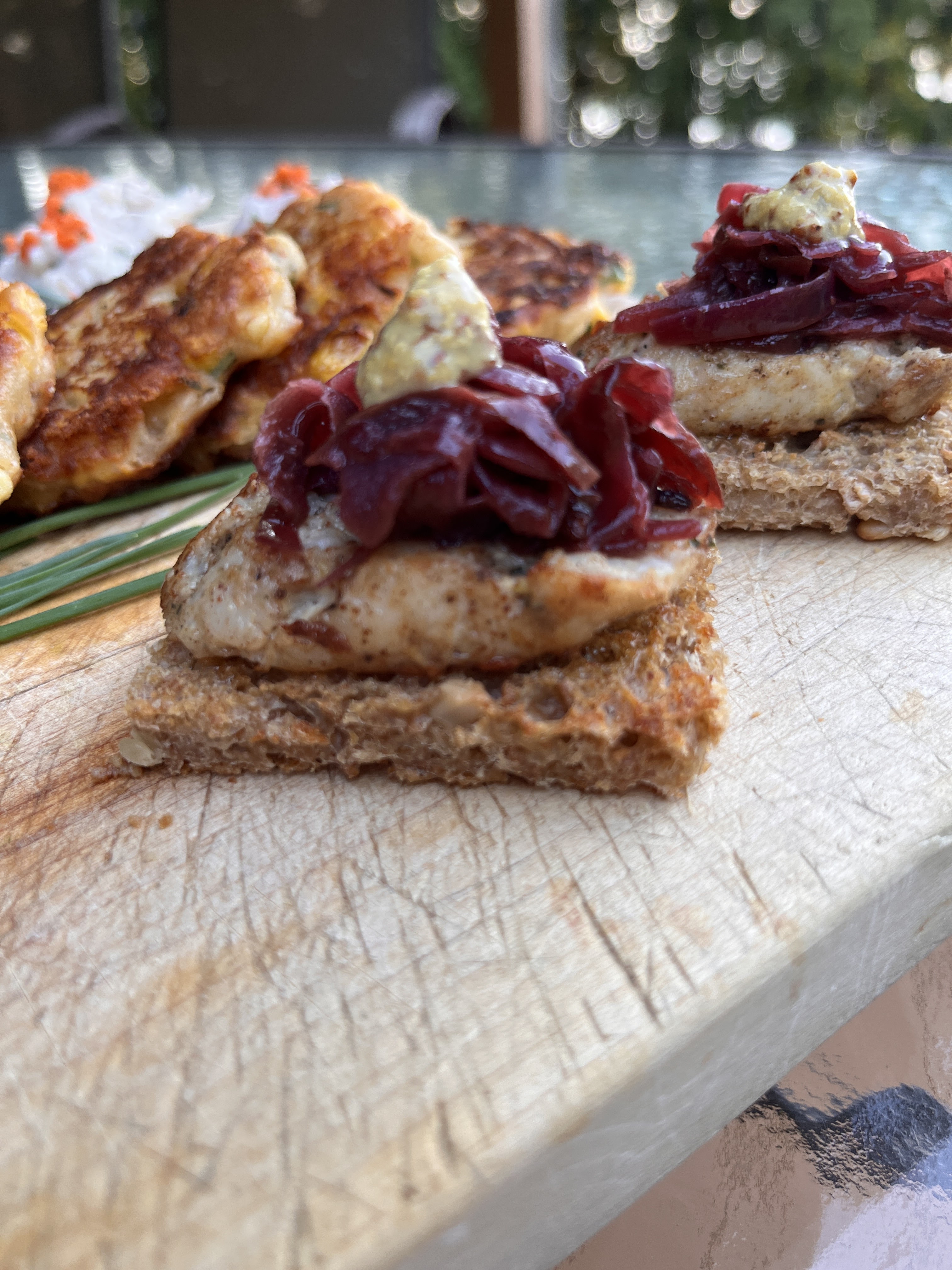
In a large cast iron pan over medium high heat, melt the butter and then add the red onions. Stir occasionally and cook until slightly browned on edges, then add red cabbage and a dash of salt. As cabbage begins to wilt, add apple cider vinegar and liquid smoke, turn down to low and cover the pan. Cook until vinegar is fully absorbed and cabbage has softened. Taste test for an end product that is softened with some residual texture, similar to a hearty sauer kraut.
Service notes:
Cut off crusts of the toasted bread and cut each slice into four squares, each about 2 inches by 1.5 inches. Cut whitefish brats into 1/2 inch slices on an angle. Top with warm cabbage and a dot of stone ground mustard.
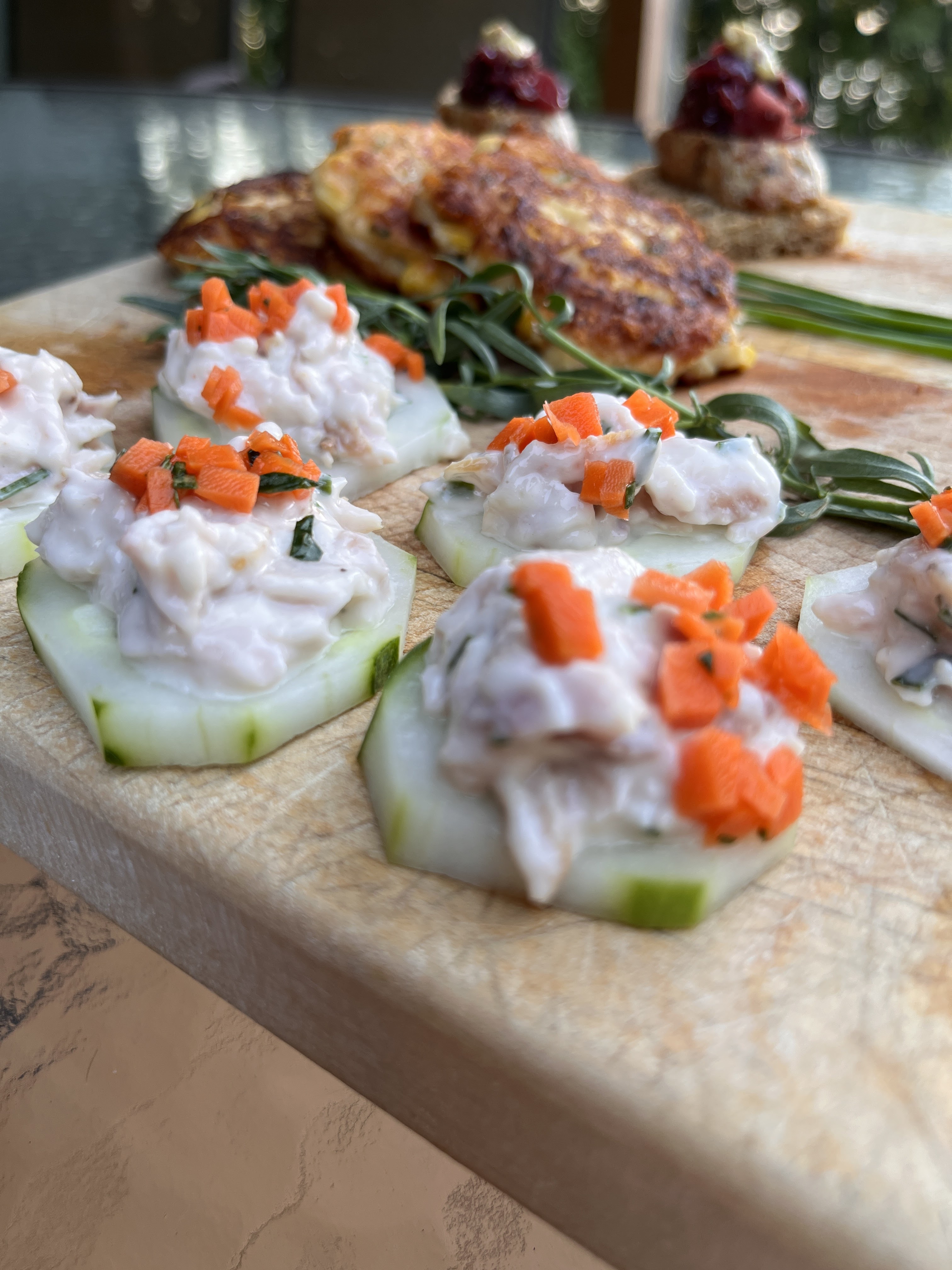
Our other offering on the service platter is a smoked whitefish dip, prepared similarly to our smoked trout dip, served on cucumber rounds with house-made pickled carrots with tarragon. Here are a couple additional plating options:

We served smoked trout dip with broccoli sprouts and fresh radish and a leaf of tarragon. The other preparation is smoked trout dip with tarragon, pickled radish, half of a baby cherry tomato, and a dot of Forager Chef’s Green Goddess dressing.
 Great Lakes Cuisine